Tag Archives: toxic trespass

What Do You Think About Accommodating Someone With MCS/ES or Allergies?

Some people think they have the right to do whatever they want, regardless of how it affects anyone else around them. Sometimes what they do is from ignorance (not knowing or understanding causes and effects), sometimes it’s a deliberately hurtful, even criminal action. Either way, what they do causes all kinds of suffering that is fully preventable.

Here are a few images you can think about and share if they “speak” to you:

telling 1

Continue reading

‘Conceptual Breakthrough’ Regarding the Chemicals We’re Stewing In

This is BIG news in the everyday chemicals and human health research front!

This explains what many of us who have MCS/ES experience – we can feel these processes as they occur, we don’t have to wait for the cancer that will kill us if we don’t get away from the exposures and find tools to heal the already occurring damage.

chemical effects

‘Conceptual breakthrough’

“This is the first time scientists have figured out how widespread this is, and how many different layers of machinery within the cells themselves are being impacted by these chemicals.”

.

“We found definite evidence that chemicals that are unavoidable in the environment can produce a wide range of low-dose effects that are directly related to carcinogenesis. So the way we’ve been testing chemical safety is really quite out-of-date.”

“Every day we are exposed to an environmental ‘chemical soup’ and we need testing to evaluate the effects of our ongoing exposure to the mixtures in this soup.”

~ William Goodson III, a senior scientist at the California Pacific Medical Center in San Francisco.


“This research backs up the idea that chemicals not considered harmful by themselves are combining and accumulating in our bodies to trigger cancer and might lie behind the global cancer epidemic we are witnessing.

~ Cancer Biologist Dr Hemad Yasaei from Brunel University London

.

This would be all kinds of everyday chemicals, such as those that trigger MCS – they included chemicals found in items such as mobile phones, detergents and cooking pans, and pesticides used on fruits and vegetables!

Read the research or check out some of the media reports:

Continue reading

Show You Care, Clear the Air!

Apparently fragranced items (including toys) are  top sellers as Christmas gifts (and for other occasions). Unless you have told everyone you know NOT to get you anything fragranced, there’s a high likelihood that you’ve recently received something aromatic, something that you may or may not understand the consequences of having and using.

Most people have no idea that these and other products that stink contain harmful chemicals that damage our health (as well as the health of future generations). We don’t know because these ingredients are secret (unlabeled), unregulated, and we have not been educated.

For those of you who are beginning to understand there’s a problem,  and having been the unfortunate recipient of a toxic gift from a well-meaning friend or family member, but have wondered what exactly you can do about it (other than thinking of regifting it * please don’t), here is an up and coming post-gift-giving-receiving activity you can take to let vendors and manufacturers know you won’t accept their toxic secrets!

Continue reading

The Fragrance Industry’s Toxic Secrets

If you want to learn more about why so many people are suffering adverse health effects and making a stink about fragrance use, then the recent report from Women’s Voices for the Earth is a great place to get informed

Unpacking the Fragrance Industry: Policy Failures, the Trade Secret Myth and Public Health.

It’s must read material if you are at all unfamiliar with the issues surrounding fragrance.

Like this:

And that’s only the ones that have been tested. Many have not been tested for human health effects. Scientists also recently discovered that chemical cocktails can become carcinogenic even when individual chemicals themselves weren’t carcinogenic, but chemicals are tested individually (if at all), and not in the cocktails we get exposed to.

Please read the research and articles from WVE, and then take action.

Not surprisingly, the fragrance industry took issue with the report and shared some standard industry generated marketing responses. You can read about that here:

Continue reading

When 90% of Us Share 12.3% of the Pie

I can’t get this out of my mind, as it really brings into focus why so many people have become chronically ill, and are dying younger from devastating new health problems and increasingly early  deaths (including suicides), because our true health and well-being is not profitable, and therefore what is needed is not available.

When access to safe, non-toxic, healthy air to breathe, water to drink, homes to live in, clothing to wear, health care, and other necessities of life are denied to so many people because everything that is manufactured now is made with so many toxic chemicals, including our food, because our current system allows corporations to pollute us for profit, without paying any of the costs (some of which are priceless), when the environment we depend on for life is destroyed and treated like a garbage dump, (as are our minds and bodies) then we are not going to survive as a species for much longer.

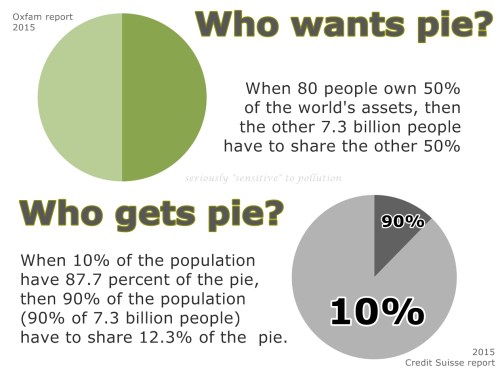
When 10% of the population is hoarding 87.7% of the global asset pie, and when 90% of us have just 12.3% of the pie, how many have no access to pie at all?

This has to change if we are to have future human generations on this planet, the only place which is uniquely suitable to provide what we need to live healthy, loving lives, if only we would respect and care for it and each other!

Think about this, over and over again, until it sinks in…

When 80 people own 50% of the world’s assets, then everyone else (the other 7.3 billion people who live on this planet) have to share the other 50%. (Oxfam, 2015)

That is, 7.3 BILLION people share 1/2 of the pie, while just 80 people share the other half… but it gets worse:

“Since the release of the Oxfam report in January, Credit Suisse released a new report validating the concern for the acceleration of global income disparity as the richest ten percent of people now hold 87.7 percent of all wealth.”
 

pie

Meaning some portion of  90% of the population have 12.3% of the global pie…

This is a very graphic view of what is wrong in the world today, why so many people are seriously sick and dying at astonishingly younger ages (as several new reports this year show), and why so many of us don’t have access to even very basic needs.

I believe that we can work together to bring things back into harmony with each other and the planet that supports our lives and existence.

We have to act now to change this, and it starts with reconnecting with our hearts!

Continue reading

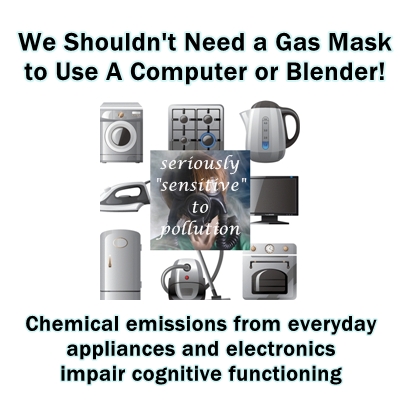
We Shouldn’t Need a Gas Mask to Use A Computer or Blender!

Ever notice how when you buy a new appliance or electronic device, and take it out of the box, or plug it in, the smell makes you nauseous, dizzy, and gives you a headache? Or worse?

That smell is made up of some really toxic chemical fumes. Benzene, styrene, and toluene, among others… in everyday technology!

.

New research from the Exposure, Epidemiology & Risk Program, Department of Environmental Health, Harvard T.H. Chan School of Public Health, on how the pollutants in indoor environments affect people’s cognitive functioning (people who are still able to work in polluted offices, not the people who are already too disabled to work in polluted offices) discovered that

Green office environments linked with higher cognitive function scores

…”People who work in well-ventilated offices with below-average levels of indoor pollutants and carbon dioxide (CO2) have significantly higher cognitive functioning scores–in crucial areas such as responding to a crisis or developing strategy–than those who work in offices with typical levels, according to a new study from the Harvard T.H. Chan School of Public Health’s Center for Health and the Global Environment, SUNY Upstate Medical University, and Syracuse University.

“We have been ignoring the 90%. We spend 90% of our time indoors and 90% of the cost of a building are the occupants, yet indoor environmental quality and its impact on health and productivity are often an afterthought,” said Joseph Allen, assistant professor of exposure assessment science, director of the Healthy Buildings Program at the Harvard Center for Health and the Global Environment, and lead author of the study.

“These results suggest that even modest improvements to indoor environmental quality may have a profound impact on the decision-making performance of workers.”

Researchers wanted to look at the impact of ventilation, chemicals, and carbon dioxide on workers’ cognitive function because, as buildings have become more energy efficient, they have also become more airtight, increasing the potential for poor indoor environmental quality.

Building-related illnesses and “sick building syndrome” were first reported in the 1980s as ventilation rates decreased. In response, there has been an emphasis on sustainable design–“green” buildings that are energy efficient and are also designed to enhance indoor environmental quality. The researchers designed this study to identify the specific attributes of green building design that influence cognitive function, an objective measure of productivity.

“The major significance of this finding lies in the fact that these are the critical decision making parameters that are linked to optimal and productive functioning. Losing components of these skills impacts how people handle their day to day lives.”

In other words, pollution prevents people from being smart!

appliance gas mask

Here are just some of the harmful emissions from computers:

Continue reading

Down is Harder After Up

Alternate title: Be Grateful or Be Miserable!

I had some really good brain and body days in the early spring, enough that they left an imprint on me of how it felt to feel (relatively, and almost) normal. instead of the usual:

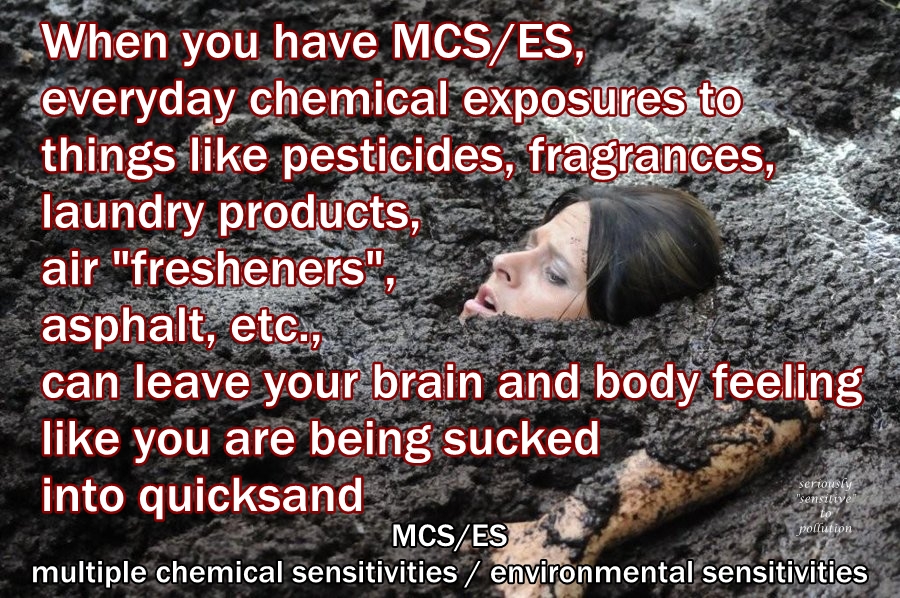
feels like quicksand-3

Then shit happened… (sorry, I don’t usually use language like that, but I’ve lost access to some parts of my vocabulary lately as a result of the toxic stuff I was exposed to).

Pesticides, dental infections and extractions, toxic products and materials (including trying to replace a SS kitchen kettle -simple, yes? Actually, NO), summer road work, more and more pesticides, heat,  VOCs, lack of ventilation and air filtration, which meant no ability to cook, and more…all of which resulted in some serious brain fog, cognitive problems,  and drastically reduced physical abilities.

Back to the drawing board…

After having some good days this year, I crashed again, and I haven’t been able to recover… much… There can be a few better mini-moments here and there if the outdoor air quality is exceptional and the breezes have been blowing the “right” way, but nothing like how well I was doing for a while in the spring.

Which makes it so much harder now, because I can actually remember what it was like to be more functional. It was so long ago before, that it didn’t really come into play or into my thoughts, as for so many years, I couldn’t remember what it was like to think clearly, or to function without effort, with relative ease.

Is it really too much to ask to be able to function with relative ease? To not have every thought, every action be like climbing a mountain or navigating an obstacle course?

Continue reading

“Artificial scents have no place in our hospitals”

Canada’s top medical journal, the Canadian Medical Association Journal (CMAJ), says
Artificial scents have no place in our hospitals

Hospital NO Fragrance

“These patients may be involuntarily exposed to artificial scents from staff, other patients and visitors, resulting in worsening of their clinical condition. As patients,
family members and emergency physicians will attest, the attacks can be quite sudden and serious. There is little justification for continuing to tolerate artificial scents in our
hospitals.” …

Continue reading

When They Poisoned the Pests, I Didn’t Care

waves 1c


When they poisoned the pests,

I didn’t care, because I wasn’t a pest…

When they poisoned the frogs,

I didn’t care, because I was not a frog…

When they poisoned the birds,

I didn’t care, because I wasn’t a bird…

When they poisoned the air,

I didn’t care, because it was on the other side of the planet…

When they poisoned the ocean,

I didn’t care, because I wasn’t a fish…

When they poisoned the lands,

I didn’t care, because it wasn’t near my land…

When they poisoned the people,

I didn’t care, because it wasn’t anyone in my family…

(besides, those people with MCS/ES were acting all crazy, wanting me to change my laundry products, stop using fragrances, and get rid of my wi-fi, among other things)

Continue reading

Shouldn’t Cleaning Products REMOVE Pollutants Instead of ADDING Them?

Here’s yet another scientific report about how dangerous chemicals and VOCs are being released from the everyday cleaning products most people use in their homes!

Environmental Defense (Canada) recently released their report THE DIRTY TRUTH, which found that products from some of the biggest cleaning brands (Mr. Clean, Clorox, Lysol, Windex, and PineSol ) pollute the air in Canadians’ homes with harmful chemicals. (Note that these products are not significantly, if at all different in the US, but the EU does have some bans on ingredient that are still allowed here).

ED’s The Dirty Truth follows hot on the heels of Women’s Voices For the Earth’s DEEP CLEAN report, and while both of these reports name names, they had a slightly different focus.

In Deep Clean, Women’s Voices For the Earth graded four major cleaning product manufacturers based on key indicators to expose their commitment to product safety: Product Ingredient Disclosure, Responsiveness to Consumer Concerns, Toxic Chemical Screening Process and Removal of WVE’s Chemicals of Concern.

Dr. Anne Steinemann’s research from earlier this year did not name product names, but she named numerous harmful volatile organic chemicals (VOCs) that the many popular products she tested do release into the air we breathe.

One has to wonder why this is allowed to be going on?

We should not be subjected to harmful industrial pollutants in our own homes!

cleaning pollution 1.

“Our new report found that products from some of the biggest cleaning brands (Mr. Clean, Clorox, Lysol, Windex, and PineSol ) pollute the air in Canadians’ homes with harmful chemicals called Volatile Organic Compounds. These chemicals have been linked to respiratory problems such as asthma and lower IQs.”

.

 Volatile Organic Compounds and Your Health

Continue reading