Here’s a good three minute PSA from Frederick Community College about going fragrance-free:
∴
More resources:
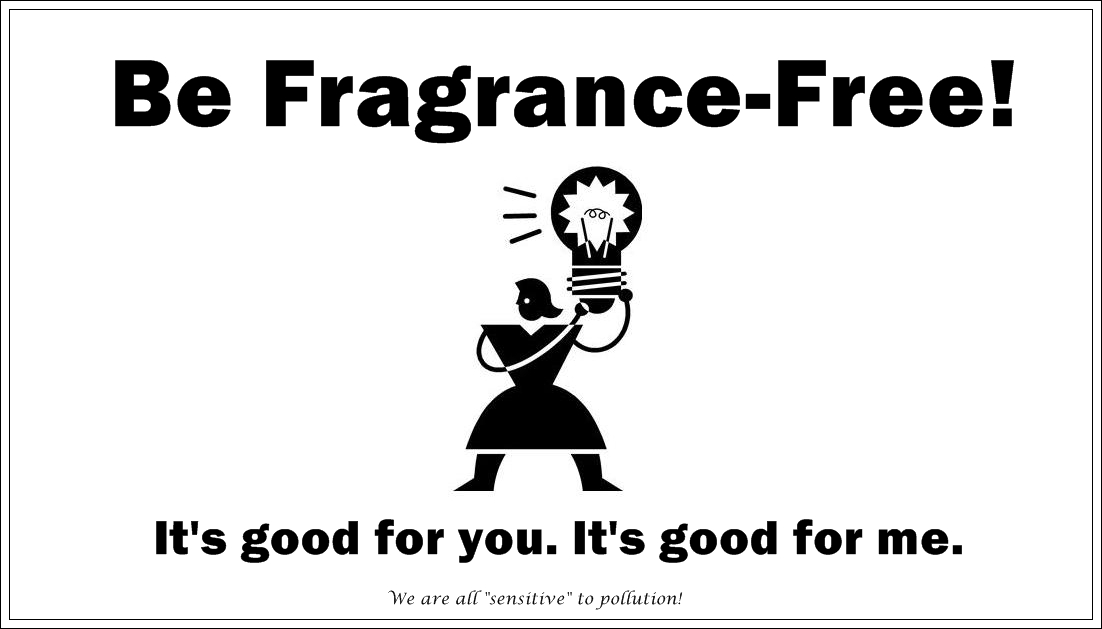
Fragrance chemical pollution is as harmful as smoke, and has serious short and long term impacts on health and productivity.

Here’s a good three minute PSA from Frederick Community College about going fragrance-free:
∴
More resources:
Fragrance chemical pollution is as harmful as smoke, and has serious short and long term impacts on health and productivity.
“In other words, though work to reduce toxic chemical exposures can be viewed as quite distinct from efforts to address EMF exposures, both EMFs and EDCs can disrupt the critical signaling systems in the body and lead to problematic health endpoints.”

written by Elise Miller, MEd
CHE Director
 As you probably remember from your high school biology class, our bodies function using electrical impulses to communicate between cells, such as telling your heart muscles to contract or signaling your brain that you just stubbed your toe. Since everything relies on these signals, any breakdown or disruption in your body’s electrical system can become a real problem.
We also know that certain toxic agents, such as endocrine disrupting chemicals (EDCs), can alter our bodies’ hormonal messaging systems (which, by the way, uses electrical signals to communicate). When exposures to these chemicals, even in tiny amounts, happen during critical windows of development, then a wide range of health problems can result over a person’s lifetime.
So what do EDCs and electromagnetic fields (EMFs) have in common? As Henry C. Lai, professor of bioengineering at the University of Washington in Seattle and an expert…
View original post 434 more words
Posted in Chemicals, EMF, Environmental Health, Health
Tagged EHS, EMF/EMR, endocrine disruption, living with MCS / ES, wireless

The following sound-video is 6 1/2 minutes long and adds some detail to one of the health challenges described in
A Story That Needs To Be Heard: Part 1
(please listen to Part 1 first, if you can)
Here is Part 2
Posted in Brain, Disability, EMF, Environmental Sensitivities, Health, Wireless
Tagged disability, discrimination., EHS, EMF, frequencies, Housing, Lyme Disease, MCS, MCS/ES, multiple chemical sensitivities, new products, noise, sensitivity, sound, wireless, wireless dangers
I invite you to take 25 minutes of your life to listen to this audio documentary.
Posted in Air Quality, Child Health, Disability, Environmental Health, Environmental Sensitivities, Health, Human Rights
Tagged challenges, chronic conditions, discrimination., EHS, environment, health, Housing, immune dysfunction, Lyme Disease, MCS/ES, multiple chemical sensitivities, pain, surviving, Sylvain, systemic, toxic chemicals, toxic trespass
The June 2014 edition of the Canadian Family Physician journal contains a couple of excellent articles by Dr Stephen J. Genuis. Here’s the abstract and link to one of them:
Approach to patients with unexplained multimorbidity with sensitivities
Abstract:
Objective To explore the underlying causation of unexplained multimorbidity with sensitivities and to discuss the management of patients who present with this perplexing condition.
Sources of information Medical and scientific literature was used from MEDLINE (PubMed), several books, toxicology and allergy journals, conference proceedings, government publications, and environmental health periodicals.
Main message Multimorbidity with sensitivities has become an increasingly common and confusing primary care dilemma. Escalating numbers of debilitated individuals are now presenting to family physicians and specialists with multisystem health complaints, including sensitivities and fatigue, with no obvious causation, a paucity of laboratory findings, and a lack of straightforward solutions. In the recent scientific literature, there is discussion of sensitivity-related illness, an immune-mediated disorder that frequently manifests with multisystem symptoms, commonly including sensitivities and fatigue.
Posted in Environmental Health, Environmental Sensitivities, Health, MCS/ES, Public Health
Tagged allergies, asthma, baking soda, chronic, disability, discrimination., environmental sensitivities, exposures, fatigue, Food, Fragrance, Mold, multiple chemical sensitivities, multisystem, mycotoxins, pain, pesticides, petrochemicals, Research, Stephen J. Genuis
There are days that I am not as peaceful as I would like to be… This is one of them…
Despite most of my fantasies being about a world where we all have clean air, clean water, healthy food, safe shelter and clothing, and care about each others well-being, I admit to occasionally entertaining various “revenge” fantasies regarding those who allow toxic chemicals into everyday products and materials, especially those in the fragrance industry…
I have had different fantasies over the years, despite in my heart of hearts, not wanting anyone to suffer…Today another revenge fantasy emerged (since some people just don’t understand the harm their actions cause others, unless they personally experience the same or similar harm):
The people who allow toxic chemicals to be used in colognes and other fragranced products deserve to be locked into a room with no ventilation, to inhale the fumes from 20 opened bottles and packages of those products (like soaps, laundry, personal care and cleaning products) for 24 hours, no matter what happens to them while they are in there.
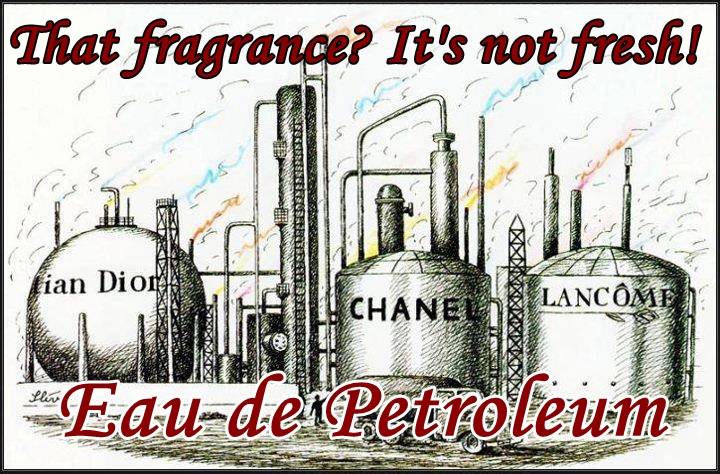
With their families and friends watching via live-stream somewhere else…
Ok, I’ll be a little considerate…maybe when they go unconscious or delirious, they could be taken to a hospital, to a room filled with toxic sanitizers, PVC/vinyl fumes, perfumed and cologned doctors and nurses… only to be told that their symptoms were all in their head.
Why, you might ask, would I wish such a thing on someone today?
A mother’s thoughts on having a daughter with disabling MCS

 I asked my mom for the ultimate act of love this week. I asked her tell about her journey having a daughter who is disabled with MCS. Mom asked me for questions for her to answer. These are her words:
1. What did you first think when I told you I was disabled with MCS and you would have to eliminate all toxic chemicals from your life if you wanted to physically see me?
I thought, God. How do we do that — chemicals are everywhere? How bad is this going to get for my poor daughter? And of course, I thought about myself also. I have lived for so long doing everything using all kinds of awful stuff and not even paying attention until you get an awful wake up call and have to hope and pray it is not too late.
2. Two years after my disability from…
View original post 1,027 more words
Posted in Child Health, Disability, Environmental Health, Health, MCS/ES, Multiple Chemical Sensitivities
Tagged change, family, fragranced products, MCS
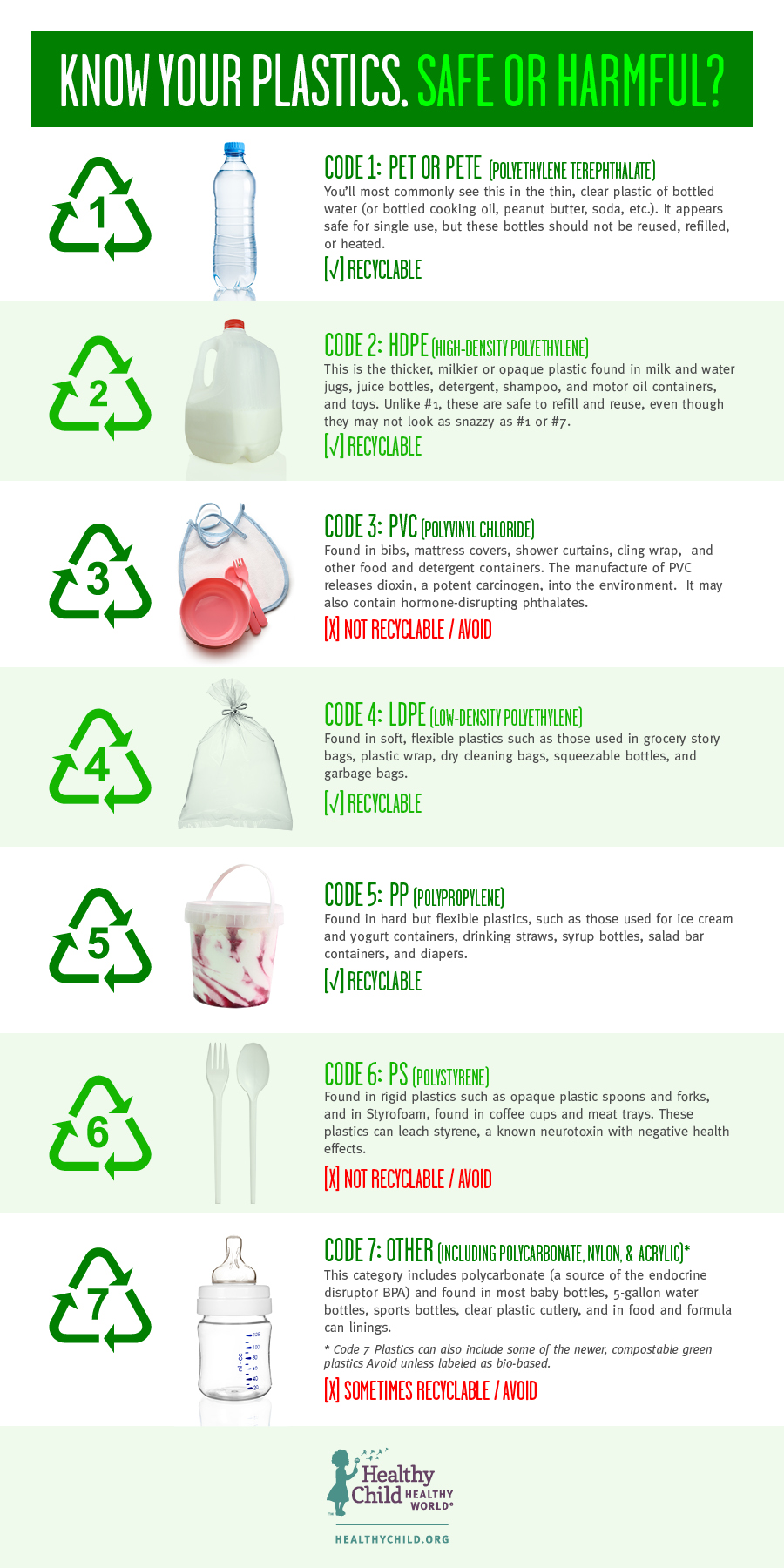
What if all the articles about safer plastics for foods and beverages were actually mistaken about these materials being safe around anything meant to be swallowed?
You know, the ones that say to avoid using containers with some symbols on the bottom, but those with other symbols are safe to use with your foods and drinks?
Like this one:

Guess what?
“The Society of the Plastics Industry (SPI) introduced its resin coding system in order to identify the various resins found in plastic bottles and rigid containers and to make sorting and recycling plastic bottles and containers easier for recyclers in Canada.
Despite the similarity in appearance between the SPI symbols and the Mobius loop, the presence of an SPI code does not indicate that the product is recyclable or is recycled locally.
Nor is it meant as a guide for safe use for food or beverage contact, or as an indicator of the intended use of the bottle or container…”
From: https://www.ic.gc.ca/eic/site/oca-bc.nsf/eng/ca02747.html

But that’s not all…
“According to a new study by the Food Packaging Forum, 175 chemicals with known hazardous properties are legally used in the production of food contact packaging in Europe and the U.S.”
!!!
I’ve written about endocrine disrupting chemicals in food before.

I just ran across a nice short video from the Massachusetts Breast Cancer Coalition, featuring Ruthann Rudel, the Director of Research at Silent Spring Institute describing the problem and how eating real food for just three days decreased the levels of BPA and phthalates in the people tested.
What we eat matters. There’s more we can do. Watch:
Posted in Environmental Health, Food, Health
Tagged avoiding chemicals, BPA, cancer, endocrine disrupting chemicals, phthalates, real food, Silent Spring Institute
This is not surprising news, given what is being allowed and encouraged as economic activity these days.
 (click to enlarge image)
 | linda @ Seriously "S… on MCS/ES |
| linda @ Seriously "S… on The CDC and MCS |
 | Tabatha Schnorr on MCS/ES |
| Tabatha Schnorr on The CDC and MCS |
| linda @ Seriously "S… on MCS and Housing |
| linda @ Seriously "S… on Hospital Protocols for People… |


 Seriously "Sensitive" to Pollution