Category Archives: Human Rights

The Fragrance Industry’s Toxic Secrets

If you want to learn more about why so many people are suffering adverse health effects and making a stink about fragrance use, then the recent report from Women’s Voices for the Earth is a great place to get informed

Unpacking the Fragrance Industry: Policy Failures, the Trade Secret Myth and Public Health.

It’s must read material if you are at all unfamiliar with the issues surrounding fragrance.

Like this:

And that’s only the ones that have been tested. Many have not been tested for human health effects. Scientists also recently discovered that chemical cocktails can become carcinogenic even when individual chemicals themselves weren’t carcinogenic, but chemicals are tested individually (if at all), and not in the cocktails we get exposed to.

Please read the research and articles from WVE, and then take action.

Not surprisingly, the fragrance industry took issue with the report and shared some standard industry generated marketing responses. You can read about that here:

Continue reading

Industrial Engineering Students Learn That EHS is a Functional Impairment… and More About Wireless

This presentation by Professor Olle Johansson about the biological and health effects of  electromagnetic pollution was given to a group of Industrial Engineering students in Barcelona, Spain and was recorded in October 2015. We are fortunate to be able to have access to easy to understand scientific presentations of this caliber.

Pr Olle Johansson presentation

Professor  Johansson, from the Neuroscience department at Karolinska Institutet in Sweden, starts by saying the first problem is that they have no women in the class and then discussed how EHS is recognized as a functional impairment in Sweden, and how the environment must be modified to accommodate and include people with a functional impairment. (His recently published paper on the subject is also available below). He went on to describe other issues with wireless radiation and encouraged the class to come up with solutions.

I think it’s worth taking the time to watch, but I like learning about the things that are affecting our lives, and what we can and have to do now and to protect future generations, so that they have a chance at more than mere survival.

Adverse health effects of modern electromagnetic fields from wireless telecommunication, such as mobile phones and WiFi

Continue reading

Scent Marketing or Scented Drugging?

The May June 2015 issue of Costco’s magazine had an article about scent marketing.

The Economist had an interesting article in 2007 regarding manipulative chemical use.

Women’s Voices For the Earth has several reports about fragrances and the fragrance industry.

Why should you be concerned? Read on:

Continue reading

When 90% of Us Share 12.3% of the Pie

I can’t get this out of my mind, as it really brings into focus why so many people have become chronically ill, and are dying younger from devastating new health problems and increasingly early  deaths (including suicides), because our true health and well-being is not profitable, and therefore what is needed is not available.

When access to safe, non-toxic, healthy air to breathe, water to drink, homes to live in, clothing to wear, health care, and other necessities of life are denied to so many people because everything that is manufactured now is made with so many toxic chemicals, including our food, because our current system allows corporations to pollute us for profit, without paying any of the costs (some of which are priceless), when the environment we depend on for life is destroyed and treated like a garbage dump, (as are our minds and bodies) then we are not going to survive as a species for much longer.

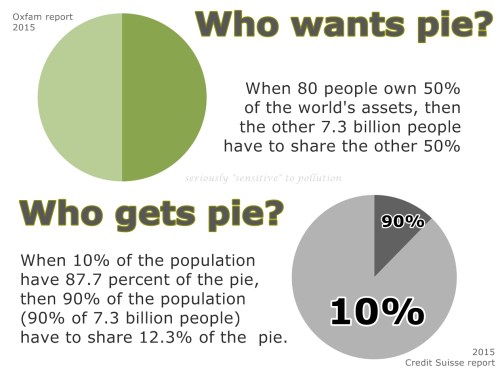
When 10% of the population is hoarding 87.7% of the global asset pie, and when 90% of us have just 12.3% of the pie, how many have no access to pie at all?

This has to change if we are to have future human generations on this planet, the only place which is uniquely suitable to provide what we need to live healthy, loving lives, if only we would respect and care for it and each other!

Think about this, over and over again, until it sinks in…

When 80 people own 50% of the world’s assets, then everyone else (the other 7.3 billion people who live on this planet) have to share the other 50%. (Oxfam, 2015)

That is, 7.3 BILLION people share 1/2 of the pie, while just 80 people share the other half… but it gets worse:

“Since the release of the Oxfam report in January, Credit Suisse released a new report validating the concern for the acceleration of global income disparity as the richest ten percent of people now hold 87.7 percent of all wealth.”
 

pie

Meaning some portion of  90% of the population have 12.3% of the global pie…

This is a very graphic view of what is wrong in the world today, why so many people are seriously sick and dying at astonishingly younger ages (as several new reports this year show), and why so many of us don’t have access to even very basic needs.

I believe that we can work together to bring things back into harmony with each other and the planet that supports our lives and existence.

We have to act now to change this, and it starts with reconnecting with our hearts!

Continue reading

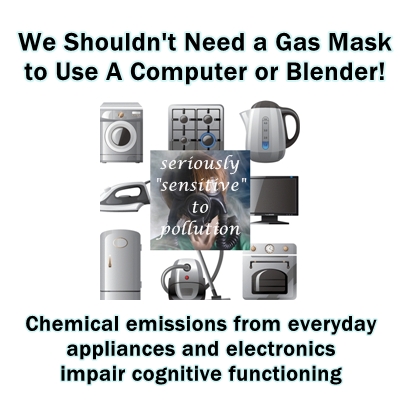
We Shouldn’t Need a Gas Mask to Use A Computer or Blender!

Ever notice how when you buy a new appliance or electronic device, and take it out of the box, or plug it in, the smell makes you nauseous, dizzy, and gives you a headache? Or worse?

That smell is made up of some really toxic chemical fumes. Benzene, styrene, and toluene, among others… in everyday technology!

.

New research from the Exposure, Epidemiology & Risk Program, Department of Environmental Health, Harvard T.H. Chan School of Public Health, on how the pollutants in indoor environments affect people’s cognitive functioning (people who are still able to work in polluted offices, not the people who are already too disabled to work in polluted offices) discovered that

Green office environments linked with higher cognitive function scores

…”People who work in well-ventilated offices with below-average levels of indoor pollutants and carbon dioxide (CO2) have significantly higher cognitive functioning scores–in crucial areas such as responding to a crisis or developing strategy–than those who work in offices with typical levels, according to a new study from the Harvard T.H. Chan School of Public Health’s Center for Health and the Global Environment, SUNY Upstate Medical University, and Syracuse University.

“We have been ignoring the 90%. We spend 90% of our time indoors and 90% of the cost of a building are the occupants, yet indoor environmental quality and its impact on health and productivity are often an afterthought,” said Joseph Allen, assistant professor of exposure assessment science, director of the Healthy Buildings Program at the Harvard Center for Health and the Global Environment, and lead author of the study.

“These results suggest that even modest improvements to indoor environmental quality may have a profound impact on the decision-making performance of workers.”

Researchers wanted to look at the impact of ventilation, chemicals, and carbon dioxide on workers’ cognitive function because, as buildings have become more energy efficient, they have also become more airtight, increasing the potential for poor indoor environmental quality.

Building-related illnesses and “sick building syndrome” were first reported in the 1980s as ventilation rates decreased. In response, there has been an emphasis on sustainable design–“green” buildings that are energy efficient and are also designed to enhance indoor environmental quality. The researchers designed this study to identify the specific attributes of green building design that influence cognitive function, an objective measure of productivity.

“The major significance of this finding lies in the fact that these are the critical decision making parameters that are linked to optimal and productive functioning. Losing components of these skills impacts how people handle their day to day lives.”

In other words, pollution prevents people from being smart!

appliance gas mask

Here are just some of the harmful emissions from computers:

Continue reading

When Programmers Send Old Computers Into ICU and Palliative Care

My computer and old Operating System have seen better days. Things are crashing almost hourly now. I am so grateful that the original donor was twice able to get this computer back up again (with telephone advice) after a partial freeze and fully appearing meld-down, but it is still malfunctioning online, so I have to shut it down frequently, as the sites I use seem to have updated using technology that is no longer inclusive of XP and my  minimal RAM (adding more would be cost-prohibitive).

I  therefore find myself in critical need of a new computer, even with all the toxicity and adverse health risks involved, and without the time to mitigate them (like running things somewhere else that is also fragrance free, for however long it takes to off-gas everything).

Eeks! image from pixabay 2

Here are some details:

Continue reading

Why We Need “Sensitive” Human Canaries

“Sensitive” humans are not defective or here to inconvenience you.

maybe it is not me

Some canary history:

“Carbon monoxide, a potentially deadly gas devoid of color, taste or smell, can form underground during a mine fire or after a mine explosion.

Today’s coal miners must rely on carbon monoxide detectors and monitors to recognize its presence underground. However, before the availability of modern detection devices, miners turned to Mother Nature for assistance.

Canaries — and sometimes mice — were used to alert miners to the presence of the poisonous gas. Following a mine fire or explosion, mine rescuers would descend into the mine carrying a canary in a small wooden or metal cage.


Any sign of distress from the canary was a clear signal that the conditions underground were unsafe, prompting a hasty return to the surface.


Continue reading

Guest Post: Euthanasia and Disability Rights

Monique and I both live in Ontario, Canada, where there are new discussions happening both provincially and federally regarding “assisted suicide”, “death with dignity”, the right to die, and euthanasia (I may have missed a few other terms used).

We both have MCS/ES, and are confronted with systemic discrimination and barriers to access with almost every breath we take. Breathing is not optional. And we are not alone. There are hundreds of thousands of us in Canada, and millions around the world.

Open letter in support of Euthanasia and Rights for those with diseases that defy accommodations

Guest Post by Monique

I Am Easy to Ignore

I am female
I am over 60
I am divorced and alone
I am a student
I have lower employability
I have invisible disability
I was abused
I have depression + ADD.
I do not feel strong

The biggest and most painful ordeal is people who lack the ability to reduce the perfumes they wear in public… who value their vanity above the good of others. I cannot exist without the kindness of strangers. I do not want to live without my Right to life-sustaining air. I do not want to explain why I cannot breathe your scents and subsist in the lifestyle you value and have grown attached to. I cannot live in your chemical soup.

I am a canary. I have MCS. Although canaries have saved many from disasters, their deaths are never celebrated. I feel like I will soon be sacrificed so that many will continue to breathe good quality air.

I would like to give a voice to those canaries. I’d like to call upon every canary on this planet to stand up and be counted. I want every canary not to die in vain. Continue reading

Accessible Meetings Guide Addresses Chemical and Electrical Sensitivities

Another great resource shared by Mary Lamielle, this time on how to make events accessible for people with MCS/ES.

Accessible Meetings Guide Addresses Chemical and Electrical Sensitivities

accessible events

Continue reading

The Effort and “Inconvenience” of Single-Handedly Trying to Remove Systemic Barriers to Access

.

When she needed accommodation, you won’t believe the rigmarole that ensued.

(unless you have MCS/ES)

equal opportunity 1

“They should not have to make significantly more effort to access or obtain service. They should also not have to accept lesser quality or more inconvenience.”

.

Someone with MCS (who wishes to remain anonymous) was asked about how her efforts to receive appropriate, safe, accommodation were going, so she could see a health care provider. She is one of a growing number of people who become disabled from exposures to toxic chemicals found in many everyday products and materials, especially in fragrances.

This is pretty much how the story goes:

She contacted a health care provider by phone and talked to a receptionist.

She asked her if they had a scent-free policy and was told they didn’t.

Continue reading